 About the Island
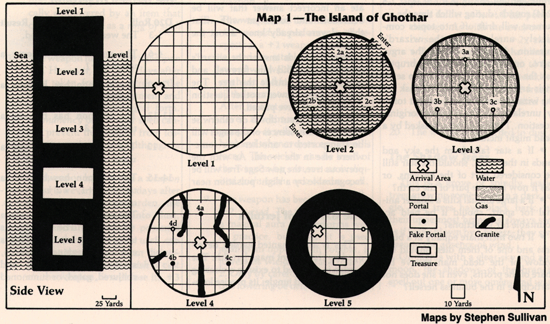
Refer to Map 1.
The island resembles a cylinder about 50 yards in diameter and about 165 yards
tall. Nearly three-fourths of it is submerged, meaning that only about 35
yards of the island is above sea level. The island is made of granite; the granite
is permanently surrounded with a wall of force, making it virtually invulnerable to damage.
The island is divided into five levels, each about 25 yards tall from top to
bottom (except for Level 1, which corresponds to the surface of the island). The
floors are solid granite nearly 10 feet thick, permanently covered with wall of force.
The only passageways between levels are the magical portals located at various
points on the floors (see map). The portals are 5-foot-diameter rings made of
black and white pearls imbedded in the granite. The portals are completely
airtight. When a creature or person touches the granite area inside the ring of
pearls, the creature or person is instantly transported to a specific location on
the island. The destination of each portal is indicated in the Map Key
Map Key
Level 1: This is the surface of the island, the only portion that is visible above sea
level. There is a portal on the center of the island. Those stepping on the
portal are instantly transported to a random area in Level 2, abruptly finding
themselves underwater.
Level 2: This level is completely filled with sea water. There are two
10-foot-diameter openings on either side of this level leading to the open sea. Depending on
where in the world the island happens to be, this level could contain various
forms of dangerous sea life who have taken shelter here; such sea life might
include sharks, giant eels, or giant octopi.
2a. Portal: Those stepping on this portal are instantly transported to the top of the
island (to the area marked with an X on the Level
1 map).
2b. Portal: Those stepping on this portal are instantly transported to the floor of Level
3 (to the area on the Level 3 map marked with an X).
2c. Portal: Those stepping on this portal are instantly transported to the floor of Level
4 (to the area on the Level 4 map marked with an X).
Level 3: This level is completely filled with a noxious yellow gas that smells like
dead fish. The gas is so dense that normal vision is reduced to 10 feet.
Characters entering this level must save vs. poison; those who fail suffer 1-2 hit
points of damage per round of exposure to the gas.
3a. Portal: Those stepping on this portal are instantly transported to a random area in
Level 2, finding themselves suddenly underwater.
3b. Portal: Those stepping on this portal are instantly transported to the top of the
island (to the area marked with an X on the Level 1 map).
3c. Portal: Those stepping on this portal are instantly transported to the floor of Level
4 (to the area on the Level 4 map marked with an X. )
Level 4: This level has floor-to-ceiling walls of granite that divide the level into
various sections. The walls are one foot thick and are permanently covered with wall of force.
4a, 4b, 4c. Fake Portals: These circles of pearls resemble the portals found on other levels of the
island, but they are not portals. Instead, when any character steps on one of
these fake portals, he activates a special monster summoning III spell. The spell instantly summons 1d4 3rd-level monsters (selected by the DM
from his 3rd-level encounter tables). The summoned monsters appear near the
ring's perimeter and attack everyone in sight. If the monsters are killed, they
disappear; otherwise, they fight for 2-8 (2d4) rounds, after which time they
vanish. There is no effect if the monsters step inside one of the fake portals.
The monsters will avoid the real portal (4d).
4d. Portal: Those stepping on this portal are instantly transported to the floor of Level
5 (to the area on the Level 5 map marked with an X. )
Level 5: This is Ghothar's treasure cache. The exact composition of the treasure is the
decision of the DM, but a suggested cache includes a spell book with a dozen
conjuration/summoning spells of various levels, five magical items, and an
assortment of gold and gems worth 20,000 gp. (Rumors abound that Ghothar found the
secret of eternal life and still exists in an alternate plane of existence; if
this is true, Ghothar might return someday to restock his cache with a different
assortment of treasure. He might also change the traps in his island,
especially if his previous treasure has been stolen.)
Those stepping on the portal on this level are instantly transported to the
top of the island (to the area marked with an X on the Level 1 map).
The Sphere of B'naa
The Sphere of B'naa is located in a cavern beneath one of the world's highest
peaks. Its precise location is not known. The sphere was created eons ago by a
consort of wizards led by a high-level mage named B'naa. The sphere supplied
transport for the wizards to alternate planes of existence. Because of the magic
involved in creating and sustaining the sphere, it is extremely difficult to
use and virtually impossible to use by non-wizards
About the Island
Refer to Map 1.
The island resembles a cylinder about 50 yards in diameter and about 165 yards
tall. Nearly three-fourths of it is submerged, meaning that only about 35
yards of the island is above sea level. The island is made of granite; the granite
is permanently surrounded with a wall of force, making it virtually invulnerable to damage.
The island is divided into five levels, each about 25 yards tall from top to
bottom (except for Level 1, which corresponds to the surface of the island). The
floors are solid granite nearly 10 feet thick, permanently covered with wall of force.
The only passageways between levels are the magical portals located at various
points on the floors (see map). The portals are 5-foot-diameter rings made of
black and white pearls imbedded in the granite. The portals are completely
airtight. When a creature or person touches the granite area inside the ring of
pearls, the creature or person is instantly transported to a specific location on
the island. The destination of each portal is indicated in the Map Key
Map Key
Level 1: This is the surface of the island, the only portion that is visible above sea
level. There is a portal on the center of the island. Those stepping on the
portal are instantly transported to a random area in Level 2, abruptly finding
themselves underwater.
Level 2: This level is completely filled with sea water. There are two
10-foot-diameter openings on either side of this level leading to the open sea. Depending on
where in the world the island happens to be, this level could contain various
forms of dangerous sea life who have taken shelter here; such sea life might
include sharks, giant eels, or giant octopi.
2a. Portal: Those stepping on this portal are instantly transported to the top of the
island (to the area marked with an X on the Level
1 map).
2b. Portal: Those stepping on this portal are instantly transported to the floor of Level
3 (to the area on the Level 3 map marked with an X).
2c. Portal: Those stepping on this portal are instantly transported to the floor of Level
4 (to the area on the Level 4 map marked with an X).
Level 3: This level is completely filled with a noxious yellow gas that smells like
dead fish. The gas is so dense that normal vision is reduced to 10 feet.
Characters entering this level must save vs. poison; those who fail suffer 1-2 hit
points of damage per round of exposure to the gas.
3a. Portal: Those stepping on this portal are instantly transported to a random area in
Level 2, finding themselves suddenly underwater.
3b. Portal: Those stepping on this portal are instantly transported to the top of the
island (to the area marked with an X on the Level 1 map).
3c. Portal: Those stepping on this portal are instantly transported to the floor of Level
4 (to the area on the Level 4 map marked with an X. )
Level 4: This level has floor-to-ceiling walls of granite that divide the level into
various sections. The walls are one foot thick and are permanently covered with wall of force.
4a, 4b, 4c. Fake Portals: These circles of pearls resemble the portals found on other levels of the
island, but they are not portals. Instead, when any character steps on one of
these fake portals, he activates a special monster summoning III spell. The spell instantly summons 1d4 3rd-level monsters (selected by the DM
from his 3rd-level encounter tables). The summoned monsters appear near the
ring's perimeter and attack everyone in sight. If the monsters are killed, they
disappear; otherwise, they fight for 2-8 (2d4) rounds, after which time they
vanish. There is no effect if the monsters step inside one of the fake portals.
The monsters will avoid the real portal (4d).
4d. Portal: Those stepping on this portal are instantly transported to the floor of Level
5 (to the area on the Level 5 map marked with an X. )
Level 5: This is Ghothar's treasure cache. The exact composition of the treasure is the
decision of the DM, but a suggested cache includes a spell book with a dozen
conjuration/summoning spells of various levels, five magical items, and an
assortment of gold and gems worth 20,000 gp. (Rumors abound that Ghothar found the
secret of eternal life and still exists in an alternate plane of existence; if
this is true, Ghothar might return someday to restock his cache with a different
assortment of treasure. He might also change the traps in his island,
especially if his previous treasure has been stolen.)
Those stepping on the portal on this level are instantly transported to the
top of the island (to the area marked with an X on the Level 1 map).
The Sphere of B'naa
The Sphere of B'naa is located in a cavern beneath one of the world's highest
peaks. Its precise location is not known. The sphere was created eons ago by a
consort of wizards led by a high-level mage named B'naa. The sphere supplied
transport for the wizards to alternate planes of existence. Because of the magic
involved in creating and sustaining the sphere, it is extremely difficult to
use and virtually impossible to use by non-wizards
 About the Spheres
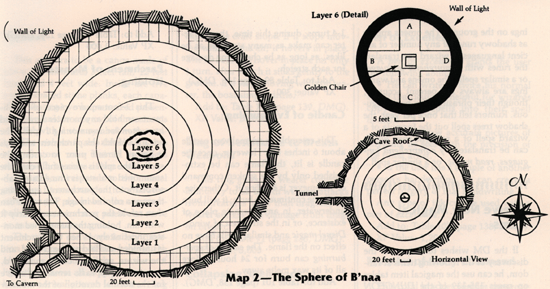
Refer to Map 2.
The sphere is located in an immense cavern at the end of a 200 yard long
passage winding deep inside the earth beneath an ancient, towering mountain range.
The sphere consists of several layers (like an onion), each about 20 feet thick.
The layers are separated from one another by bands of shimmering white light.
The portal to the alternate planes lies in the center of the sphere; to get to
the portal, a person must pass through each layer.
Once the magical requirement for a layer has been met, characters may pass
through the layer of shimmering light to the next layer. If any character passes
back through a light layer that he has already passed through, the magical
condition must be met again in order to re-enter that light layer. Characters may
pass freely toward the outer spheres (for example, from layer 4 to layer 3).
Each layer is permanently enchanted with special features representing the
various levels of wizard magic; for instance, the first layer of the sphere
represents 1st-level wizard magic, the second layer represents 2nd-level wizard
magic, and so on. If the proper level of spell is cast on a layer, its features
change dramatically; these spells can either be cast on the layer itself or on any
subject inside the layer. Magical items that duplicate the effects of spells do
nothing to change the features of the plane, nor do priest spells. The effects
are explained in detail in the Map Key.
Map Key
Layer 1: This layer is filled with brightly blinking lights of all colors. Those in
contact with this layer must save vs. spells or become blinded for the next 2-8
(2d4) rounds. If any 1st-level wizard spell is cast at the layer or at a
character inside the layer, the layer instantly fills with dancing lights and characters no longer risk being blinded. The dancing lights persist for one turn, after which the layer reverts to its original features.
Layer 2: This layer is filled with greenish-yellow fog that obscures all sight, normal
and infravision, beyond two feet. Those in contact with this layer suffer 1-4
hit points of damage per round (save for half-damage). If any 2nd-level wizard
spell is cast at the layer or at a character inside the layer, the fog
instantly becomes harmless, similar to the fog produced by fog cloud, and characters no longer risk suffering damage. The harmless fog cloud persists for one turn, after which the layer reverts to its original
features.
Layer 3: This layer is dark and empty, but a powerful gust of wind of about 30 m.p.h. blows from the inner wall toward the outer wall, rendering
man-sized creatures unable to proceed to Layer 4. If any 3rd-level wizard
spell is cast at the layer or at a character inside the layer, the wind subsides to
a gentle breeze and characters can proceed normally. The gentle breeze
persists for one turn, after which the strong wind begins to blow again.
Layer 4: This layer is filled with roaring red flames similar to those produced by a fire trap. Those in contact with this layer must save vs. spells or suffer 5-8 (1d4+4)
hit points of damage (save for half damage). If any 4th-level wizard spell is
cast at the layer or at a character inside the layer, the flames turn green and
no longer generate heat; characters suffer no damage from the green flames. The
green flames persist for one turn, after which the layer is again filled with
roaring red flames.
Layer 5: This layer is solid granite, similar to that produced by wall of stone. If any 5th-level wizard spell is cast at the layer, the granite disappears,
revealing the bands of shimmering white light that border the final layer
(Layer 6) of the sphere. The granite reappears in one turn.
Layer 6: This is a 20-foot-diameter hollow sphere containing a structure made of
shimmering white light. The structure rests at ground level (relative to the cavern
that the entire sphere lies within). The shimmering structure has four
openings, all leading to a central area containing a golden chair. A character can walk
to the chair through one of the openings, sit down, and instantly be
transported to another plane of existence.
Opening A: If a character walks through this opening, he will be transported instantly
to the Ethereal planes when he sits in the golden chair. He will be transported
to any specific location in the Ethereal planes he has in mind; otherwise, he
will be transported to a random location in the Ethereal planes.
Opening B: If a character walks through this opening, he will be transported instantly
to the inner planes when he sits in the golden chair. He will be transported to
any specific location in the inner planes he has in mind; otherwise, he will be
transported to a random location in a randomly chosen inner plane.
Opening C: If a character walks through this opening, he will be transported instantly
to the outer planes when he sits in the golden chair. He will be transported to
any specific location in the outer planes he has in mind; otherwise, he will be
transported to a random location in a randomly chosen outer plane.
Opening D: If a character walks through this opening, he will be transported instantly
to the Astral plane when he sits in the golden chair. He will be transported to
any specific location in the Astral plane he has in mind; otherwise, he will be
transported to a random location in the Astral plane.
The Sage Tree
The Sage Tree is a huge oak tree about 10 feet in diameter and over 100 feet
tall. It grows somewhere in one of the world's densest forests. The Sage Tree
contains the spirits of a dozen of the wisest scholars who ever lived. After the
scholars died, the gods of good rewarded their devotion to pure knowledge by
placing their spirits in this oak so they could engage in philosophic discussions
for all eternity.
If a wizard locates this oak (recognizable by a slight pulsation near its
trunk that resembles a heart beat), he can ask it any question as if he were
consulting a wise sage for information (the wizard can ask any question relating to
the fields of study listed on Table 61 of the DUNGEON MASTER Guide). The Sage Tree will only respond to wizards of lawful good alignment, and
it will answer only one question per day.
If these requirements are met, two to five (1d4 + 1) human faces will sprout
from the tree in an area five to ten feet above the base of the trunk. The faces
appear to be carved from wood. One of the faces will politely ask the wizard
to repeat the question, then another face will offer an answer. Immediately, a
second face will offer a different answer. If there are additional faces, they
too will offer different answers.
After all of the faces have offered their answers, they will ignore the wizard
and engage in a heated argument as to who is wrong and who is right. The
argument will continue for at least 2-8 (2d4) rounds, during which time the argument
will drift off into topics completely unrelated to the wizard's question. At
some point in the argument, one of the heads will abruptly ask the wizard for
his opinion to settle their argument--the head will ask for the wizard's opinion
on a subject totally unrelated to the wizards' original question. Typical
questions asked by a head might include:
· If a star falls from the sky and lands in the ocean, should the star still be
considered part of the heavens, or has it now become part of the earth?
· If a large animal kills a smaller animal for sport, should it be held
accountable for its actions?
· If two men share equally in a business and one of them dies, should the widow
of the dead man receive his share of the profits, even if she does not
participate in the business herself?
· Are a wizard's skills more important than those of a craftsman? Than those of
an artist?
· In what ways is a dragon the equal of a man?
If the wizard refuses to answer the head's question, all of the heads withdraw
into the tree trunk and disappear. They cannot be summoned again for another
24 hours.
If the wizard makes a reasonable effort to answer the head's question (the DM
decides if the wizard has made a reasonable effort), the heads will nod in
agreement, saying they will discuss the issue further at another time. One of the
heads will then ask the wizard to repeat his original question. The heads will
consult briefly with each other, then one of them will answer the question. To
determine if the heads have arrived at the correct answer, the DM should roll
1d20. On a roll of 18 or less, the heads have answered correctly. On a roll of 19
or 20, the heads have answered incorrectly. The DM should create an incorrect
answer that will be believable and consistent with what they players already
know about the adventure.
After the heads answer the wizard's question, they bid him farewell and
withdraw back inside the tree. The heads will not answer another question until 24
hours have passed.
If the tree is cut down or otherwise destroyed, the essences of the sages will
be transported to another tree somewhere else in the world. As with the
previous tree, the new Sage Tree will be recognizable by a slight pulsation near its
trunk
The Garden of Jertulth
This in a clearing in an uncharted jungle; its precise location is not known.
The garden is only about 10 feet by 10 feet square, but its enchantment is so
strong that it radiates magic for a radius of one mile.
The garden appears to be a normal bed of wild flowers of various types.
However, if a non-magical weapon is buried in the garden beneath three feet of soil
and left undisturbed for a year and a day, there is a good chance that it will
change into a magical weapon. No more than two weapons can be buried in the
garden at the same time; if more than two weapons are buried, the enchantment will
not work and the weapons will be unaffected.
If a weapon is removed from the garden before a year and a day have passed,
the magic is negated; the weapon must be buried again, and another year and a day
must pass before the enchantment takes hold. If a weapon remains buried in the
garden for a year and a day, roll 1d20 and consult Table 20 for the result.
Table 20: Results from the Garden of Jertulth
About the Spheres
Refer to Map 2.
The sphere is located in an immense cavern at the end of a 200 yard long
passage winding deep inside the earth beneath an ancient, towering mountain range.
The sphere consists of several layers (like an onion), each about 20 feet thick.
The layers are separated from one another by bands of shimmering white light.
The portal to the alternate planes lies in the center of the sphere; to get to
the portal, a person must pass through each layer.
Once the magical requirement for a layer has been met, characters may pass
through the layer of shimmering light to the next layer. If any character passes
back through a light layer that he has already passed through, the magical
condition must be met again in order to re-enter that light layer. Characters may
pass freely toward the outer spheres (for example, from layer 4 to layer 3).
Each layer is permanently enchanted with special features representing the
various levels of wizard magic; for instance, the first layer of the sphere
represents 1st-level wizard magic, the second layer represents 2nd-level wizard
magic, and so on. If the proper level of spell is cast on a layer, its features
change dramatically; these spells can either be cast on the layer itself or on any
subject inside the layer. Magical items that duplicate the effects of spells do
nothing to change the features of the plane, nor do priest spells. The effects
are explained in detail in the Map Key.
Map Key
Layer 1: This layer is filled with brightly blinking lights of all colors. Those in
contact with this layer must save vs. spells or become blinded for the next 2-8
(2d4) rounds. If any 1st-level wizard spell is cast at the layer or at a
character inside the layer, the layer instantly fills with dancing lights and characters no longer risk being blinded. The dancing lights persist for one turn, after which the layer reverts to its original features.
Layer 2: This layer is filled with greenish-yellow fog that obscures all sight, normal
and infravision, beyond two feet. Those in contact with this layer suffer 1-4
hit points of damage per round (save for half-damage). If any 2nd-level wizard
spell is cast at the layer or at a character inside the layer, the fog
instantly becomes harmless, similar to the fog produced by fog cloud, and characters no longer risk suffering damage. The harmless fog cloud persists for one turn, after which the layer reverts to its original
features.
Layer 3: This layer is dark and empty, but a powerful gust of wind of about 30 m.p.h. blows from the inner wall toward the outer wall, rendering
man-sized creatures unable to proceed to Layer 4. If any 3rd-level wizard
spell is cast at the layer or at a character inside the layer, the wind subsides to
a gentle breeze and characters can proceed normally. The gentle breeze
persists for one turn, after which the strong wind begins to blow again.
Layer 4: This layer is filled with roaring red flames similar to those produced by a fire trap. Those in contact with this layer must save vs. spells or suffer 5-8 (1d4+4)
hit points of damage (save for half damage). If any 4th-level wizard spell is
cast at the layer or at a character inside the layer, the flames turn green and
no longer generate heat; characters suffer no damage from the green flames. The
green flames persist for one turn, after which the layer is again filled with
roaring red flames.
Layer 5: This layer is solid granite, similar to that produced by wall of stone. If any 5th-level wizard spell is cast at the layer, the granite disappears,
revealing the bands of shimmering white light that border the final layer
(Layer 6) of the sphere. The granite reappears in one turn.
Layer 6: This is a 20-foot-diameter hollow sphere containing a structure made of
shimmering white light. The structure rests at ground level (relative to the cavern
that the entire sphere lies within). The shimmering structure has four
openings, all leading to a central area containing a golden chair. A character can walk
to the chair through one of the openings, sit down, and instantly be
transported to another plane of existence.
Opening A: If a character walks through this opening, he will be transported instantly
to the Ethereal planes when he sits in the golden chair. He will be transported
to any specific location in the Ethereal planes he has in mind; otherwise, he
will be transported to a random location in the Ethereal planes.
Opening B: If a character walks through this opening, he will be transported instantly
to the inner planes when he sits in the golden chair. He will be transported to
any specific location in the inner planes he has in mind; otherwise, he will be
transported to a random location in a randomly chosen inner plane.
Opening C: If a character walks through this opening, he will be transported instantly
to the outer planes when he sits in the golden chair. He will be transported to
any specific location in the outer planes he has in mind; otherwise, he will be
transported to a random location in a randomly chosen outer plane.
Opening D: If a character walks through this opening, he will be transported instantly
to the Astral plane when he sits in the golden chair. He will be transported to
any specific location in the Astral plane he has in mind; otherwise, he will be
transported to a random location in the Astral plane.
The Sage Tree
The Sage Tree is a huge oak tree about 10 feet in diameter and over 100 feet
tall. It grows somewhere in one of the world's densest forests. The Sage Tree
contains the spirits of a dozen of the wisest scholars who ever lived. After the
scholars died, the gods of good rewarded their devotion to pure knowledge by
placing their spirits in this oak so they could engage in philosophic discussions
for all eternity.
If a wizard locates this oak (recognizable by a slight pulsation near its
trunk that resembles a heart beat), he can ask it any question as if he were
consulting a wise sage for information (the wizard can ask any question relating to
the fields of study listed on Table 61 of the DUNGEON MASTER Guide). The Sage Tree will only respond to wizards of lawful good alignment, and
it will answer only one question per day.
If these requirements are met, two to five (1d4 + 1) human faces will sprout
from the tree in an area five to ten feet above the base of the trunk. The faces
appear to be carved from wood. One of the faces will politely ask the wizard
to repeat the question, then another face will offer an answer. Immediately, a
second face will offer a different answer. If there are additional faces, they
too will offer different answers.
After all of the faces have offered their answers, they will ignore the wizard
and engage in a heated argument as to who is wrong and who is right. The
argument will continue for at least 2-8 (2d4) rounds, during which time the argument
will drift off into topics completely unrelated to the wizard's question. At
some point in the argument, one of the heads will abruptly ask the wizard for
his opinion to settle their argument--the head will ask for the wizard's opinion
on a subject totally unrelated to the wizards' original question. Typical
questions asked by a head might include:
· If a star falls from the sky and lands in the ocean, should the star still be
considered part of the heavens, or has it now become part of the earth?
· If a large animal kills a smaller animal for sport, should it be held
accountable for its actions?
· If two men share equally in a business and one of them dies, should the widow
of the dead man receive his share of the profits, even if she does not
participate in the business herself?
· Are a wizard's skills more important than those of a craftsman? Than those of
an artist?
· In what ways is a dragon the equal of a man?
If the wizard refuses to answer the head's question, all of the heads withdraw
into the tree trunk and disappear. They cannot be summoned again for another
24 hours.
If the wizard makes a reasonable effort to answer the head's question (the DM
decides if the wizard has made a reasonable effort), the heads will nod in
agreement, saying they will discuss the issue further at another time. One of the
heads will then ask the wizard to repeat his original question. The heads will
consult briefly with each other, then one of them will answer the question. To
determine if the heads have arrived at the correct answer, the DM should roll
1d20. On a roll of 18 or less, the heads have answered correctly. On a roll of 19
or 20, the heads have answered incorrectly. The DM should create an incorrect
answer that will be believable and consistent with what they players already
know about the adventure.
After the heads answer the wizard's question, they bid him farewell and
withdraw back inside the tree. The heads will not answer another question until 24
hours have passed.
If the tree is cut down or otherwise destroyed, the essences of the sages will
be transported to another tree somewhere else in the world. As with the
previous tree, the new Sage Tree will be recognizable by a slight pulsation near its
trunk
The Garden of Jertulth
This in a clearing in an uncharted jungle; its precise location is not known.
The garden is only about 10 feet by 10 feet square, but its enchantment is so
strong that it radiates magic for a radius of one mile.
The garden appears to be a normal bed of wild flowers of various types.
However, if a non-magical weapon is buried in the garden beneath three feet of soil
and left undisturbed for a year and a day, there is a good chance that it will
change into a magical weapon. No more than two weapons can be buried in the
garden at the same time; if more than two weapons are buried, the enchantment will
not work and the weapons will be unaffected.
If a weapon is removed from the garden before a year and a day have passed,
the magic is negated; the weapon must be buried again, and another year and a day
must pass before the enchantment takes hold. If a weapon remains buried in the
garden for a year and a day, roll 1d20 and consult Table 20 for the result.
Table 20: Results from the Garden of Jertulth
| D20
|
|
| Roll
| Result
|
|
|
|
| 1-3
| The weapon is unaffected.
|
|
|
|
| 4-6
| The weapon has become a weapon +1.
|
|
|
|
| 7-10
| The weapon has become a weapon +2.
|
|
|
|
| 11-12
| The weapon has become a weapon +3.
|
|
|
|
| 13
| The weapon has become a weapon +4.
|
|
|
|
| 14-15
| The weapon has become a weapon +1, +2 vs. magic-using and enchanted creatures. This weapon always provides a +1 bonus. The +2 bonus takes effect when the
sword is employed against wizards, spell-casting monsters, and conjured, gated,
or summoned creatures. (The +2 bonus will not operate against a creature
magically empowered by an item that casts spells, such as a ring of spell storing.
|
|
|
|
| 16
| The weapon has become a weapon +3. However, 2-8 (2d4) days after it is taken from the garden, the weapon loses
its enchantment and reverts to its non-magical form. Permanency or a similar spell cannot prevent the weapon from losing its enchantment,
although a wish could.
|
|
|
|
| 17
| The weapon has become a weapon +3. However, 2-8 (2d4) days after it is taken from the garden, the weapon
disintegrates into dust. This enchantment is so powerful that nothing short of a wish can prevent the weapon from disintegrating; however, if a wish is cast on the weapon, it will lose its +3 bonus and revert to a normal
weapon.
|
|
|
|
| 18
| The weapon has become a weapon +1, cursed. It performs in all respects as a +1 weapon, but when it is used to attack an
enemy, the sword will weld itself to the welder's hand and force him to fight
until the enemy or the wielder is slain. After its first use, the wielder can
never rid himself of the cursed weapon--it will always appear in his hand
whenever an opponent is faced. The wielder can be freed of the weapon by remove curse, limited wish, wish, or a similar spell.
|
|
|
|
| 19
| The weapon has become a weapon -2, cursed. The weapon gives off a magical aura and performs well in practice, but when
it is used against an opponent in combat, it lowers its wielder's attack rolls
by 2. Only by careful observation can this lowering be detected. All damage
scored is reduced by 2 hit points, but a successful hit will always inflict at
least 1 hit point of damage. As with the, weapon +1, cursed the weapon -2, cursed will always appear in the hands of the wielder and
force him to fight until the enemy or the wielder is slain. The wielder can be
freed of the weapon only by a limited wish or a wish.
|
|
|
|
| 20
| The weapon has turned to dust.
|